Counseling is a difficult profession. Like other helping professions this is career desires a lot of time commitment with sometimes little monetary reward. Some of the external stressors that aid to the difficult of the job is the lack of gathering resources that are available for both the client and the counselor. The beauty of incorporating technology into to sessions is that it can help facilitate the therapeutic process. There are dictation devices that counselors can utilize in session and for case notes. Software is available for tracking clientele appointments, billing services, sending out appointment reminder messages , etc. There are so many options available for counselors that can be used to effectively reduce time set for case management. Capterra is an online website that provides software for business professionals to track documentation of their clients. This is a great site to check out for up and coming business owners.
Another alternative use for technology is to incorporate it into sessions when working in counseling as a means of having further assistance for the client. As I've stated in previous posts, there are various resources that are available when working with at-risk youth and young adults, however some of them may not always be locally. Using technology can be a buffer in-between face-to-face sessions.
Even though we can all think of the greatness that is the internet, its important that we still all remember that nothing can be as good as face-to-face sessions. Exploring other options, such as phone, text, or video counseling are all great options when they are the only methods available, but the most ideal option still remains to be in-person counseling sessions.
I would love to get all yours input, feel free to comment below!! Thanks y'all
Saturday, April 25, 2015

Tuesday, April 21, 2015
Basically.... adolescents are adults with a bit less.
What does that even mean - adolescents are adults with less? Less intelligence? Less life experiences? Less money? Less friends? The list can go on and on. So in a sense yes, that's exactly what I'm saying that adolescents are over all lesser adults than, well adults. So what does this mean for an adult working with a teenager or a middle schooler. How is knowing that you're working with a lesser adult going to impact your interaction with your client, student, patient, etc?
First lets realize that these little humans are just that - little humans. They experience the same things you do and although they might be able to put emotions to words, that doesn't mean the emotions aren't being experienced. Also these little humans, or "lesser" adults, have all the same capabilities as "bigger" adults just in small forms. Therefore like adults, they have ears to listen, mouths to speak, eyes to see, and fingers to touch, the only difference is that will "lesser" adults not all their senses are used at the same times in the same manner. You might be working with an adolescent who doesn't want to speak to you but responds well with music or writing down their feelings. This only shows that when working with adolescents you can still convey your messages to them, just in a manner that's understandable to them.
Okay, so they're also "lesser" adults what does that mean?! It means they have less capacity for handling adult-like crisis. This NPR podcast describes the age at which brain development matures. What exactly is less? Youth's ability to communicate effectively is not as high as it is for adults. Nor can adolescents effectively express their emotion. Some adolescents can connect the dots between their now actions affecting their future endeavors. These are just a few of the things adolescents consider less often then adults do.
How does this apply to at-risk youth? I believe that at-risk youth need more attention and support from their families, schools/teachers, and community leaders. I prefer to think of it as these youth are on their way to adulthood but just need more guidance along the way. Are you willing to help them?
Friday, April 10, 2015
Basically.... its almost time to start the job hunt.
So its about that time. As graduation approaches, we're faced with the dread of having to begin the job hunt. And this can be a daunting experience for those who are not well prepared, therefore today we'll discuss some steps one can take to secure a job in this fields. Below are some tips that you should consider when applying to jobs.
Tip 1: Start looking early!
Starting early allows for you to weigh out your options as to what types of jobs you'd be interested in, to look at different job opportunities, and have time to apply and go on interviews. Its important to know what opportunities are available in your community, or if you're looking to move, you'll need even more time to research all the opportunities in that area and work on developing contacts in the area. Lastly if you begin early while you're in school hopefully you'll be able to secure a position before graduation, or at least have a interviews lined up before graduation. According to this Forbes article, the best time to start applying is EARLY!! In job interviews you can let potential employers of your graduation date and the time that you would like to begin employment.
Tip 2: Use your resources y'all
So what does that mean - to use you're resources? Well that means that you should use what and who you know. For example many universities. have career centers that allow for students to come into the center to get their resumes critiqued, engage in mock interviews, and to get information about what attire might be appropriate for their job interview. Other resources may be the people in your area that are in the field that you are looking to enter. For example at my internship site a great resource for job hunting would be the counselors that I work with and ask them if they know of places hiring. Also being apart of a national association or organization would be another great avenue that you could go down. I'm a member of the ACA, America Counseling Association, and they have a section for members to post job openings or their resumes if they're looking for positions.
Tip 3: Internet sites
Monster, Indeed, and LinkedIn are just some internet sites that you can use to post your resume and look for job openings. These are also good resources because there usually tends to be reviews about the company from current or previous employers. The good thing about this method is that you can develop a template cover letter or introduction statement about yourself so that you can apply to multiple jobs, however the downside is that most likely there are hundred of thousands or millions of people who are also looking at or trying to apply fro the same job increasing the applicant pool.
Tip 4: Use Google!!
Although is this seems quite simplistic of all the suggestions, please do not underestimate the power of a good goggle search. You can use google to find more job opportunities but also to discover how to most effectively search for and apply to jobs. Google will be there to tell you how to develop the best cover letter and resume for the field that you're entering because different skills and work experiences should be highlighted when applying to different types of jobs. Google, if used properly, can be the best of the most helpful of all the tips.
So although you were only given a couple tips here, my hope is that you were enlightened you about help that is available as you embark on another milestone in your life journey. Some thing to note is that all these suggestions are free of cost to you, there are services available that you can pay for that may increase your changes of being hired however odds are these sites and services listed will suffice and will be more than enough.
Tip 1: Start looking early!
Starting early allows for you to weigh out your options as to what types of jobs you'd be interested in, to look at different job opportunities, and have time to apply and go on interviews. Its important to know what opportunities are available in your community, or if you're looking to move, you'll need even more time to research all the opportunities in that area and work on developing contacts in the area. Lastly if you begin early while you're in school hopefully you'll be able to secure a position before graduation, or at least have a interviews lined up before graduation. According to this Forbes article, the best time to start applying is EARLY!! In job interviews you can let potential employers of your graduation date and the time that you would like to begin employment.
Tip 2: Use your resources y'all
So what does that mean - to use you're resources? Well that means that you should use what and who you know. For example many universities. have career centers that allow for students to come into the center to get their resumes critiqued, engage in mock interviews, and to get information about what attire might be appropriate for their job interview. Other resources may be the people in your area that are in the field that you are looking to enter. For example at my internship site a great resource for job hunting would be the counselors that I work with and ask them if they know of places hiring. Also being apart of a national association or organization would be another great avenue that you could go down. I'm a member of the ACA, America Counseling Association, and they have a section for members to post job openings or their resumes if they're looking for positions.
Tip 3: Internet sites
Monster, Indeed, and LinkedIn are just some internet sites that you can use to post your resume and look for job openings. These are also good resources because there usually tends to be reviews about the company from current or previous employers. The good thing about this method is that you can develop a template cover letter or introduction statement about yourself so that you can apply to multiple jobs, however the downside is that most likely there are hundred of thousands or millions of people who are also looking at or trying to apply fro the same job increasing the applicant pool.
Tip 4: Use Google!!
Although is this seems quite simplistic of all the suggestions, please do not underestimate the power of a good goggle search. You can use google to find more job opportunities but also to discover how to most effectively search for and apply to jobs. Google will be there to tell you how to develop the best cover letter and resume for the field that you're entering because different skills and work experiences should be highlighted when applying to different types of jobs. Google, if used properly, can be the best of the most helpful of all the tips.
So although you were only given a couple tips here, my hope is that you were enlightened you about help that is available as you embark on another milestone in your life journey. Some thing to note is that all these suggestions are free of cost to you, there are services available that you can pay for that may increase your changes of being hired however odds are these sites and services listed will suffice and will be more than enough.
Tuesday, April 7, 2015
Basically...... how do mental health counselors differ from other helping professionals?
Recently I've found myself in social setting where the topic of discussion has been my career path compared to other helping professions. So in this post we'll go over some of the differences and similarities among various professions, specifically focusing on psychologists, psychiatrists, and different types of "counselors" that people might interact with.
Let's start by vaguely defining who a mental health counselor is and what qualifications are needed to be classified as such. A mental health counselor, MHC, is someone who is trained to treat people with behavioral, emotional, or mental issues. A MHC can either be licensed or registered (or registered intern). To become licensed one must first be registered, to become registered one has to graduate from an accredited university with a master's degree in mental health counseling. There are center qualifications, governed by the individual universities and states, that each student must obtain before graduating. Upon graduation the student then applies to become registered, again following rules that are set by each state. Every state has set requirements that have to be completed before a registered MHC can apply for licensure. Registered and licensed MHCs have ethic codes that they have to follow as well as laws that they have to abide by also. Not that we've covered MHCs, let's explore some other professions
MHC vs. Psychiatrists
Psychiatrist are medical doctors who also specialize in diagnosing and treating individuals with behavioral, emotional, or mental issues. Psychiatrists link the medicine with emotional issues, usually treating mental health issues with medication, rather than therapy like MHCs do. Many psychologist, similar to MHCs, have specific areas they specialize in that they are known for, some examples being addictions, childhood early onset, or geriatrics. Think of this as teacher who teaches a particular subject. Unlike MHCs, psychiatrists have to go through medical school and the biggest difference is that psychiatrists are the only mental health professionals that can prescribe medication for those with mental illnesses.
MHC vs Psychologist
Psychologist are graduate professionals who have doctoral degrees in Ph. D, PsyD, or EdD. Similar to MHCs, psychologists can also specialize in working with individuals with mental health issues. However psychologists can provide a host of various services, including counseling. Other aspects include research, teaching, administering and scoring assessments, and many many more other aspects of helping. Psychologist are not able to prescribe medication like psychiatrist. This link will give you more information regarding what psychologist do in their profession.
MHC vs Other counselors
There are countless "counselors" or "therapists" that are not operating within the same line of MHCs. Some of these professionals can be life coaches, religious counselors, substance abuse counselors, or other working titles that include "counselor." The main differences between these professions and MHCs is the level of education and certification needed. Some professions allow for specific courses for certification, none that are overly extensive and usually are easily attainable. Whereas other professions require no type of training, certification, or licensure at all. The issues that lie with these types of professionals is there there is no board of peers regulating the way individuals operate. In other words, there's no ethical committee making sure that your counselor is treating you to the best of their ability.
Why is it to know the differences?
Suppose you know someone who has been recently diagnosed with a mental health issue, what do you do now? Who do you speak to now? Knowing the difference helps with getting the appropriate treatment. Hope you found this to be helpful y'all.
MHC vs Psychologist
Psychologist are graduate professionals who have doctoral degrees in Ph. D, PsyD, or EdD. Similar to MHCs, psychologists can also specialize in working with individuals with mental health issues. However psychologists can provide a host of various services, including counseling. Other aspects include research, teaching, administering and scoring assessments, and many many more other aspects of helping. Psychologist are not able to prescribe medication like psychiatrist. This link will give you more information regarding what psychologist do in their profession.
MHC vs Other counselors
There are countless "counselors" or "therapists" that are not operating within the same line of MHCs. Some of these professionals can be life coaches, religious counselors, substance abuse counselors, or other working titles that include "counselor." The main differences between these professions and MHCs is the level of education and certification needed. Some professions allow for specific courses for certification, none that are overly extensive and usually are easily attainable. Whereas other professions require no type of training, certification, or licensure at all. The issues that lie with these types of professionals is there there is no board of peers regulating the way individuals operate. In other words, there's no ethical committee making sure that your counselor is treating you to the best of their ability.
Why is it to know the differences?
Suppose you know someone who has been recently diagnosed with a mental health issue, what do you do now? Who do you speak to now? Knowing the difference helps with getting the appropriate treatment. Hope you found this to be helpful y'all.
Tuesday, March 31, 2015
Basically..... how do you know when its time for change?
Much my internship work is completed by working with substance abusers. Therefore today we'll discuss the Stages of Change, a model that can be used extensively by counselors to gauge a client's willingness to change and begin a life in sobriety. There are 5 stages that clients go through in the process of getting sober.
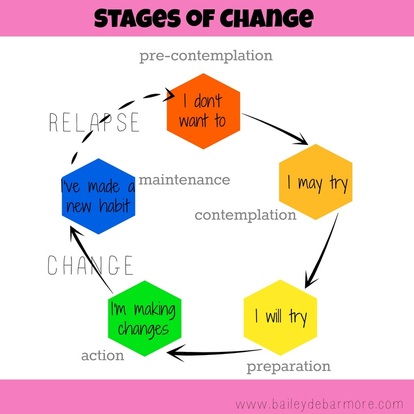
- Precontemplation - this stage there is no thought or urge to even entertain the thought of quitting substances. In this stage you as a counselor will have to roll with any resistance you might encounter from clients.
- Contemplation - step 2 is the stage where clients become aware of some of the negative consequences that they are facing due to substance abuse - but they are NOT ready to change yet. Here clients have identified a problem and are only entertaining the though of doing something different.
- Preparation - the "I want to change" stage. Here clients will be seeking change and begin going through proper steps to change. Many clients might skip this stage and go straight to the action step, which mat lead to them relapsing because they are ill prepared. Some preparations include entering rehab facilities, intensive outpatient programs, seeking out counselors, or searching for help from other professionals such as medical doctors or psychologists. This stage prepares clients for sobriety by informing them of the action and maintenance stages they'll be engaging in.
- Action - this is the actual working stage. Going to AA/NA meeting, meeting with helping professionals, changing their social setting, and/or engaging in self-directed behavioral change are just some things you can expect to see from your clients in this stage. In this stage your clients are working to remain sober, you aren't convincing them to not use but instead are strategizing with them healthy social/environmental alternatives so they can remain sober.
- Maintenance - this is where you clients will continue to do what they have learned while in the active phase. Such activities include going to AA meeting, continuing to meet with counselors, continuing to engage in activities that contribute to their sobriety. Its important to note that although AA was noted as an example, this is not a requirement for clients' sobriety, many people get sober without the help of AA or their services.
- In the case of relapse, this process begins all over the again with precontemplation. According to the National Institute on Drug Abuse, approximately 40-60% of all substance abusers relapse, so there is a high possibility that you will have clients that are constantly going through this process. Although this is not always the case and it would not be advised that you approach your clients with this mentality.
Minus the maintenance stage, which ideally should be life long, the stages of change should take a couple of months. As a counselor you should be able to see your clients progressing through the stages - also be mindful that this is not a fluid process. That means that once your clients have to fully complete one stage before moving on to the next, so if your client is looking at detox centers in one session but then continues to use - your client is still in the precontemplation/contemplation stage. Below is a diagram that expresses the stages in a circular manner (incorporating relapse into the change process.)
Here you can hear me further discuss stages of change when dealing with adolescents. Enjoy!
Friday, March 20, 2015
Basically.... Let's go international!!
As you have already suspected, people ll over the world experience depression, anxiety, suicidal ideations, bi-polar disorders, and other mental health illnesses. Today we look at international counselors, in the sense of American counselors who travel to another country to counsel and counselors in born and raised in different countries. Lets start by discussing opportunities for counseling abroad.
For those like me who are interested in traveling and living abroad, international counseling may be a route for counselors to consider. There are many jobs abroad that are now coming to seek counselors to help infleuence their communities and companies. So if you're like me, you're probably thinking "well can I go abroad to counsel?" Well of course you can! You just have to go out and look for the opportunity to do so!
Where do I start?
Glad you asked, I'll go over some job sites that are currently seeking counselors. However you should be advised that some of these job offers are through individual organizations so you should do extensive research before you go divulging your personal information online. Abroad.com has a section devoted to counseling jobs overseas, however this jobs are independent organizations. Some of the countries listed are Japan, New Zealand, China, and Germany to name a few.
International School Services has a list of international schools that are seeking counselors for different countries. However if you are not wanting to work closely with children, this site is not the one for you. Lastly USAJobs.gov has a section for recent graduates seeking employment, so for those in my position, this is an ideal place to start for me. Listed below are other sites that I've come across but have mixed feelings about their authenticity, so proceed with caution:
So I've looked over the sites and I'm ready to start the applications! But wait, what's the catch-22?
Well here are some stipulations to counseling abroad that I've come across:
For those like me who are interested in traveling and living abroad, international counseling may be a route for counselors to consider. There are many jobs abroad that are now coming to seek counselors to help infleuence their communities and companies. So if you're like me, you're probably thinking "well can I go abroad to counsel?" Well of course you can! You just have to go out and look for the opportunity to do so!
Where do I start?
Glad you asked, I'll go over some job sites that are currently seeking counselors. However you should be advised that some of these job offers are through individual organizations so you should do extensive research before you go divulging your personal information online. Abroad.com has a section devoted to counseling jobs overseas, however this jobs are independent organizations. Some of the countries listed are Japan, New Zealand, China, and Germany to name a few.
International School Services has a list of international schools that are seeking counselors for different countries. However if you are not wanting to work closely with children, this site is not the one for you. Lastly USAJobs.gov has a section for recent graduates seeking employment, so for those in my position, this is an ideal place to start for me. Listed below are other sites that I've come across but have mixed feelings about their authenticity, so proceed with caution:
- http://www.oacac.com/jobs
- http://www.learn4good.com/jobs/schoolcounselor/united_arab_emirates_uae/postings/
- http://boards.bootsnall.com/volunteeringworking-as-a-therapist-abroad-t30139.html
So I've looked over the sites and I'm ready to start the applications! But wait, what's the catch-22?
Well here are some stipulations to counseling abroad that I've come across:
- Your should be fluent in the language of the host country that you are traveling to.
- Well if you think about it this makes perfect sense, why would you hire a someone from a different country who you are unable to communicate with?
- You'll have to be licensed.
- Almost all the positions that I looked into required a licensed counselor, social work, MFT, etc. They also usually specified that there be a minimum time period that you experience in the specific job area.
- Think about it - as an employer I'll have to go through hoops to legally employ you so I better make sure you're worth the trouble!
- You might have to work in a rural area.
- Many of the positions that I've come across have been with partner organizations that are targeted at improving developing countries where you might not have certain luxuries.
- You might have to be willing to take a pay cut.
- Like I've previously stated you might be staying in rural areas where your working with a private organization that has low funding but high enthusiasm for helping others. You'll probably receive food, shelter, and other basic needs met, however there actual pay that you'll receive may be much lower than you're used to.
- This disclaimer does not apply to jobs offered through the US government, such as being a traveling counselor on military bases.
- Your position might be temporary.
- Depending on the stipulations in your contract or the agency you go through, the gig might be up in a couple months! This means that you have to consider if you're financially stable enough to move, if your family would be moving with you (if you have a partner and/or children), among many other things.
Till next time!
Tuesday, March 17, 2015
Basically.... mental health looks different on each person!
This is a little different from my normal posts, however I think that it is important to emphasize the true importance of encouraging others to seek treatment for their mental illness. At my internship site there has been a recent death of a former patient. One of the patients was going through detox and having difficulty with that experience of a newfound sobriety. This patient was a middle aged man with a wife and children, working, and an overall productive member of society. He had recently decided to stop his substance use and begin the path to sobriety. One dilemma that quickly arose for the patient was his pain increased pain from his chronic illness. Although the patient had been suffering with this pain for years, recently his pain had worsen so much that he eventually began experiencing anxiety surrounding the spontaneous onset of his pain as well as depression from his inability to stop the pain. When I saw this patient he was very much upset about his life in general, he spoke very little and when he did he spoke negatively about his life and his circumstances. Shortly after our initial meeting at the hospital, I was informed that this patient had committed suicide Initially this incident took me by surprise because I felt that there were no warning signs that he gave to me, my supervisors, or other groups members that he was even thinking or planning on committing suicide. After a couple days of dwelling on this patient, I was still highly bothered by the actions of the patient. From my perspective this patient had everything to live for, he was sober, going to seek treatment from the doctor about his pain, and was rebuilding his relationship with his family. It was at that moment that I was reminded of the magnitude of mental health on an individual. Just like other illnesses, mental health can be severe such as bi-polar disorder or schizophrenia, or less severe such as depression or anxiety. Regardless of the case, this is a serious disease that can ultimately claim one's life if untreated. One way to ensure treatment is through discussion and information of illnesses. Regularly talking about the signs and symptoms of mental illness not only normalizes it, but helps other to realize that they are not alone and that help is out there if they seek it!
Tuesday, March 3, 2015
Basically.... you don't have to do it alone!
The beauty of technology is that it can connect various people all around the world and cause strangers to feel like best friends, however that same connection can make those feel lonely once they are no longer online. This week we'll go over some websites the help bridge the gap to where the internet meets the real world.
As I'm sure you are aware of there are various blogs sites and chat rooms nowadays that allow for the people to make genuine connections and interact with likeminded individuals. (And in case you didn't realize it -you're on a blog site now!) Back to the sites and chat rooms, what happens when your computer shuts downs and you lose your internet buddy? Do you not speak to anyone else in your non-internet life? Are the only ones you can relate to only found on the internet and not within your home town/city? Well of course not silly! You find the help you need when until you can get the help you want. The question now lies in where will you find this help?
Here - Find Youth Info!! This is a great site for a plethora of reasons, one being that there is an option to find local resources that can connect you to real people in your city/town that can be of services or support. This site provides information not only for mental health illnesses, but also other issues that youth face. There is information about teen dating violence, gang prevention programs, substance abuse, LGBT youth, teen pregnancy, and those are just a few of the topics. This site also gives research information, which are empirically based - meaning that these are research papers where there have been experiments conducted and the results were reviewed by other professionals. The Map my Community link will allow for youth to connect to local resources. So lets put things into perspective. Suppose you're doing distant counseling with a youth living in an area within another state that you're unfamiliar with. Every time you speak with your client you feel as though you're making progress, but the next week you find out he was not as proactive as you would like him to be. You know your client is in always online and loves the friends he has online but doesn't think he can find "cool" people in his city. You can direct your client to the community site where he can pick from various options that he's seeking help for, including mental health, and then find the local resources. Although this sounds simple as pie, the difficulty lies in actually having your client go to meet others in person and separating themselves from the online connections and branching out.
There are many other websites that offer similar services, not only in person options but online options also. if you would like a list of blogs, websites, and other things online connection options - you can visit my information page and see the list of about 30 sites. Hope they help!
Until next time readers!!
As I'm sure you are aware of there are various blogs sites and chat rooms nowadays that allow for the people to make genuine connections and interact with likeminded individuals. (And in case you didn't realize it -you're on a blog site now!) Back to the sites and chat rooms, what happens when your computer shuts downs and you lose your internet buddy? Do you not speak to anyone else in your non-internet life? Are the only ones you can relate to only found on the internet and not within your home town/city? Well of course not silly! You find the help you need when until you can get the help you want. The question now lies in where will you find this help?
Here - Find Youth Info!! This is a great site for a plethora of reasons, one being that there is an option to find local resources that can connect you to real people in your city/town that can be of services or support. This site provides information not only for mental health illnesses, but also other issues that youth face. There is information about teen dating violence, gang prevention programs, substance abuse, LGBT youth, teen pregnancy, and those are just a few of the topics. This site also gives research information, which are empirically based - meaning that these are research papers where there have been experiments conducted and the results were reviewed by other professionals. The Map my Community link will allow for youth to connect to local resources. So lets put things into perspective. Suppose you're doing distant counseling with a youth living in an area within another state that you're unfamiliar with. Every time you speak with your client you feel as though you're making progress, but the next week you find out he was not as proactive as you would like him to be. You know your client is in always online and loves the friends he has online but doesn't think he can find "cool" people in his city. You can direct your client to the community site where he can pick from various options that he's seeking help for, including mental health, and then find the local resources. Although this sounds simple as pie, the difficulty lies in actually having your client go to meet others in person and separating themselves from the online connections and branching out.
There are many other websites that offer similar services, not only in person options but online options also. if you would like a list of blogs, websites, and other things online connection options - you can visit my information page and see the list of about 30 sites. Hope they help!
Until next time readers!!
Tuesday, February 24, 2015
Basically.... don't fight 'em - join 'em!
Ever been so stuck in your ways that you're just unwilling to even consider another method, until you're forced to try something new...and viola you find yourself in love with this new method? Well that what social media and counseling could be for you. Twitting your client? Having a live session on Second Life? Using Instagram to maintain a relationship with your client? What has the world come to? I'll tell you, its come to the modern age where you're more than likely to have a client who has at least one social media account, if not multiple. So to keep up with modernization, the most logical next step is to use social media to your advantage. We'll discuss how you could use technology with your clients.
So let's start with a discussion about the advantages of using technology with your clients. First and foremost, social media expands your clientele by....well A LOT! Dependent upon the extent that you use social media sites, your clientele can go from city wide to state wide, or even nationwide. This post on Counselor-License, helps put into perspective some benefits of incorporating social media in counseling.. Suppose you use Second Life, a 3D virtual reality world where people can interact and socialize with others as though they were in a real world setting. Through Second Life you can have clients in almost any state, which may be especially useful if you have a client who has moved but would still like to continue to see you.
Social media can also be used as addition practice for your client. If you give your client homework they might only be given one or two opportunities to apply what they've learned in their daily settings. However with social media you have use those resources and expand your client's ability to gain more practice on their learned skills. Some other advantage for your clients is the anonymity that online counseling provides. Additionally social media provides extra methods for your client to improve on their learned skills. For example you have a client who gets anxious when interviewing, you can use the media to have your client practice interviewing, reserach interviewing tips blogs, and/or join "groups" giving interviewing advise. These are just some of the ways that you can involve social media in your counseling sessions.
There are also professional social media sites that you can use with your clients to help in sessions. One of the most widely used sites for professionals is LinkedIn. This also helps with professional development to other professionals. There are many considerations one should take when using LinkedIn with a client, there should be set boundaries between you and your client. These just some of the considerations that should be taken when incorporating social media into counseling sessions.
Tuesday, February 17, 2015
Basically....here are some things to know before you email your client.
There are many factors that come into play when clients begin to take nontraditional methods of counseling, such as calling, texting, and EMAILING! As I've discussed earlier, rules of confidentiality come into play and becomes even more important to uphold when adding technology to counseling sessions. However there are other considerations that should be taken before counselors begin branching out to the world of technology.
- Communication professionalism: This means not using slang, short hand messaging, emotes, or other "cool" forms of instant messaging. Although you will be using technology and more than likely with a adolescent that uses slang terms, this is not an opportunity to begin to emulate the way that your client is speaking to you, especially if you're doing so to appear "cool". When applying to graduate school, I attended a seminar where we were told DO NOT write the way you speak. Likewise I suggest the same thing to professionals using technology with their clients. Although you should remain authentic in your transmission, you should try to avoid miscommunication to the best of your ability.
- Not okay: "Yo shawty! I hear ya and I know it be hard out in the strezz for ya yung thug"
- Okay: "Hey (client name), I understand what you're saying and I imagine these circumstances must be difficult for you."
- Privacy for you and your client: Since you will be using a third party, the internet, to transmit your information it is important to know everything you can about your this party provider. For example, Facebook states in their Terms of Service that "you grant us a non-exclusive, transferable, sub-licensable, royalty-free, worldwide license to use any IP content that you post on or in connection with Facebook (IP License). This IP License ends when you delete your IP content or your account unless your content has been shared with others, and they have not deleted it." This means that if you begin massaging your client through Facebook, that information is owned by Facebook. Other sites that provide email addresses may have similar privacy laws terms of service. Being aware of what happens to your email transcriptions is important in helping to make your client feel comfortable and to ensure confidentiality is maintained.
- Technical hiccups and backups: Although technology is God's gift to man - its still made by humans and therefore can have many faults. It is important to be aware of where your client is during your sessions. Is your client using a public facility where your emails can be hacked by an outsider? Is your client's connection reliable? Will you be storing your emails with your client and if so by what means? Will you be using internet sites like Dropbox or a personal server? What happens in the case that your client is unable to get to access their email, what is your second option? Any of these issues may arise while counseling online thus is would behove you to have secondary options in place before you begin online email counseling. Likewise it would be wise to have multiple backups in place to make sure your can assess your client's information when you need it.
These are just some of the more pressing concerns that you can address with your client when you begin internet counseling with them. The article, I love these emails, or do I?, discusses additional considerations therapists should keep in mind when conducting email counseling sessions.
Saturday, February 7, 2015
Basically.....podcasts can be your friend!
Podcasts are digital audio files on the internet that can be downloaded to personal devices. This method can be helpful because in the realm of counseling, podcast can help counselors to discover how to use specific theories or techniques. One can think of podcast as audio YouTube videos. Also being that its over the Internet, podcast allow for cross cultural integration and awareness. For the purposes of this blog, I listed a 10 podcast that are related to at-risk youth circumstances and counseling. Along with the podcasts are some topics that can be help inform counselors how to address these youth, others give indicators that a youth might be "at-risk", while some provide information about what steps can be taken while in counseling sessions. Overall all the podcasts can b seen as helpful for counselors, parents, and/or any one who has repeated contact with at-risk youth.
By selecting the Information tap above you'll be directed to the link. Today I'll discuss another podcast that is not on the list. This podcast by Ruben Austria gives advice for ways people can mentor at-risk youth. Although this can not be used in counseling, it will behove counselors to be knowledgeable about such methods as they may be able to consult for other organizations and advocate for mentorship. Rev. Austria is the Executive Director of Community Connections for Youth based out of Bronx, NY. According to CC-FY website, this is a "New-York based nonprofit organization, whose mission is to mobilize indigenous faith and neighborhood organizations to develop effective community-based alternative-to-incarceration programs for youth." You can gather more information about Rev. Austria and his organization here: CC-FY. In his podcast, Rev Austria discusses his experience in urban environments, testimonies from other mentors and mentees, and positive results from monitorships. More importantly, Rev. Austria speaks to the mentors themselves. This is a great podcast because it enlightens mentors to reluctance of their at-risk youth, it encourages mentors to be persistent and to come into their mentorship with unconditional positive regard! In addition Rev. Austria is speaking to biblical scholars such as pastors, youth leaders, and other spiritual leaders. With all that being said, here is the link that will take you directly to the podcast: Mentoring At-Risk Youth. Hope you enjoy!
Tuesday, February 3, 2015
Basically.... which is better for counseling texting, calling, or Skyping?
This week's assignment was to utilize the telephone, text messaging, and Skype services to get a sense of the feelings associated with using such technology. Today, I'll reflect over my impression after I used each method, including the pros and cons of using each method, and in what situations would each device be more useful.
Let us begin with text messaging. Acting with a partner, I was played the role of both a counselor and a client. As my partner and I began texting, it became quickly apparent that we were going to have to be mindful of not texting back to back because that lead to confusion. There were times where my counselor might make three different statements and as I replying to the first, the second came, and shortly afterwards the third one. It also was hard, as the counselor, to gauge the level of emotion that my "client" was expressing to me. I felt restricted and limited in the services I could provide because there was no way of knowing what my client needed emotionally. As the client, I felt as though I was texting a friend. I didn't feel that there was a professional relationship. After we completed the role plays we discussed our thoughts about this method of counseling. Although there were some noted advantages to texting, we both agreed that texting would not be the ideal use of technology. One aversion to texting is that the client has direct, constant access to the therapist. Can the client text any time of the day or only during business hours? Are texts chargeable, and if so how? What matters can be discussed via text? These were some of the questions that were discussed by my partner and I. On the other hand, if someone was in immediate danger and was unable to go seek help, the use of texting might be useful. Example being a child who is witnessing domestic violence among parents and is unable to call someone but has a cell phone with texting would be able to contact his/her counselor and seek help that way. These are just some of the observations that were made during our role play.
Nest we conversed over the phone. Although this was a better technique, there were still some limitations that arose. Since we could now hear each other my partner and I were able to gauge each other's level of discomfort when we role played. It was also easier to build rapport with the client. As a counselor it was easier to express empathy, validation, and other verbal words of affirmation through influx or changes in voice tone. Conversation was also easier to flow over the telephone as opposed to texting. My partner and I noticed that the relationship was more professional when we were speaking on the phone. Although we enjoyed the phone session, we were still weary of using this method. We decided that counseling clients with depression, anxiety, or similar mental health issues might fair better over the phone than clients with sever psychiatric mental health issues. Telephone calling would be good to ease the worry clients might experience in between counseling session. Similar to texting, phone counseling would be used with the intent to have the client come into the office to receive in person interviews.
Lastly we'll discuss Skype. Of all the methods to use, Skype was the most in-person like method therefore was favored between my partner and I. Using this technology allowed for the therapist to see and hear from the client thus allowing the counselor to notice the non-verbal quest that the client may display. Also Skype allows for free calls to others with Skype accounts, although may companies come with unlimited services, the option to use Skype becomes more appealing. Even in its greatness, one limitation of Skype is that it only provides the counselor with a section of the client's body therefore preventing the counselor from being able to see other non-verbals from the client. Skype, like in person sessions, prevents the counselor from "zoning out" while the client is talking or texting.
Overall there are some good and bad to all three technological methods that were utilized. Each method of communication may be beneficial in counseling if used in the proper context. One important concept that was hard to address during all scenarios was confidentiality. How can confidentiality be discussed, achieved, and maintained through texting, phone calling, or Skyping? By clicking on this link, you'll be directed to HIPPA regulations and considerations on counseling and confidentiality, while using technology.
Let us begin with text messaging. Acting with a partner, I was played the role of both a counselor and a client. As my partner and I began texting, it became quickly apparent that we were going to have to be mindful of not texting back to back because that lead to confusion. There were times where my counselor might make three different statements and as I replying to the first, the second came, and shortly afterwards the third one. It also was hard, as the counselor, to gauge the level of emotion that my "client" was expressing to me. I felt restricted and limited in the services I could provide because there was no way of knowing what my client needed emotionally. As the client, I felt as though I was texting a friend. I didn't feel that there was a professional relationship. After we completed the role plays we discussed our thoughts about this method of counseling. Although there were some noted advantages to texting, we both agreed that texting would not be the ideal use of technology. One aversion to texting is that the client has direct, constant access to the therapist. Can the client text any time of the day or only during business hours? Are texts chargeable, and if so how? What matters can be discussed via text? These were some of the questions that were discussed by my partner and I. On the other hand, if someone was in immediate danger and was unable to go seek help, the use of texting might be useful. Example being a child who is witnessing domestic violence among parents and is unable to call someone but has a cell phone with texting would be able to contact his/her counselor and seek help that way. These are just some of the observations that were made during our role play.
Nest we conversed over the phone. Although this was a better technique, there were still some limitations that arose. Since we could now hear each other my partner and I were able to gauge each other's level of discomfort when we role played. It was also easier to build rapport with the client. As a counselor it was easier to express empathy, validation, and other verbal words of affirmation through influx or changes in voice tone. Conversation was also easier to flow over the telephone as opposed to texting. My partner and I noticed that the relationship was more professional when we were speaking on the phone. Although we enjoyed the phone session, we were still weary of using this method. We decided that counseling clients with depression, anxiety, or similar mental health issues might fair better over the phone than clients with sever psychiatric mental health issues. Telephone calling would be good to ease the worry clients might experience in between counseling session. Similar to texting, phone counseling would be used with the intent to have the client come into the office to receive in person interviews.
Lastly we'll discuss Skype. Of all the methods to use, Skype was the most in-person like method therefore was favored between my partner and I. Using this technology allowed for the therapist to see and hear from the client thus allowing the counselor to notice the non-verbal quest that the client may display. Also Skype allows for free calls to others with Skype accounts, although may companies come with unlimited services, the option to use Skype becomes more appealing. Even in its greatness, one limitation of Skype is that it only provides the counselor with a section of the client's body therefore preventing the counselor from being able to see other non-verbals from the client. Skype, like in person sessions, prevents the counselor from "zoning out" while the client is talking or texting.
Overall there are some good and bad to all three technological methods that were utilized. Each method of communication may be beneficial in counseling if used in the proper context. One important concept that was hard to address during all scenarios was confidentiality. How can confidentiality be discussed, achieved, and maintained through texting, phone calling, or Skyping? By clicking on this link, you'll be directed to HIPPA regulations and considerations on counseling and confidentiality, while using technology.
Saturday, January 24, 2015
Basically....what's the 211??
Growing up one of the popular catch phrases I used to hear was "What's the for 411?!" People would say that when they entered a room and wanted to know what was currently going on at the moment. It was a popular statement in the 90s, but today I ask you all "What's the 211?"
Well I'll tell you what it is! Big Bend 211 is a 24/7 crisis hotline designed to help people with their immediate problems and putting callers in contact with local resources. Although 211 focuses on crisis stabilization, that is just the beginning of the services that they offer. From housing, counseling, family help, HIV/AIDS awareness, this agency can be considered your one stop shop. Big Bend deals mainly with suicidal calls, however they are trained to handle ALL types of callers and problems people experience. One key factor of Big Bend is that they uphold confidentiality and maintaining a non-judgement attitude. These factors helps ease the uneasiness of callers and promotes honesty from the callers. At-times it may be hard to turn to your family and friends to let them know what you're feeling at the exact moment - dial 211 then. In some cases it might be to late to call someone but there is that need to speak to someone - call 211! For some there might not be a friend or loved one to turn to, so in that case Big Bend would be prefect to call because they not only listen but they also provide resources that can attend to long-term help. Its important to remember that this is a crisis hotline, that means these counselors aren't gong to be your personal counselor, but what they're there for is to listen and to offer additional help if needed.
Here is a quick video of the Big Bend 211 in the Tallahassee area, the video gives a bit more detail regarding services offered:
** Although confidentiality is of the upmost importance, there many be cases where the agency is obligated by law to break confidentiality - however in any case where that happens, callers are informed by the counselor.**
Tuesday, January 20, 2015
What to talk about today?!
 Being a counselor I can argue that I naturally have the tendency to want to help everyone. However I know that to be the best counselor I have to develop a speciality or specific population that I focus on so that I can be somewhat of an expert in that field. With that being said, I've decided to focus this blog on resources, facts, and counseling techniques proven to be effective for at-risk and/or poverty stricken youth. Although many people might use the terms "at-risk youth" and "low-income youth" interchangeably, there most certainly is a difference. This pdf by Child Trends has done a nice job of adequately defining what an "at-risk" youth is, and what these youth are at risk of developing. In addition, one misconception is that at-risk youth are also youth living in low-income homes yet that is not the case necessarily. This Fact Sheet from the US Department of Health & Human Services shows that youth from low-, middle-, and high-income families have similar likelihood of engaging in risky behavior. All in all, this blog with enlighten you to help that may be available if you ever find yourself having to deal with an at-risk adolescent.
Tuesday, January 13, 2015
Basically...... I have no experience blogging!
My initial thoughts and feelings after class were a mixture of excitement, annoyance, curiosity, and a bit of anxiousness. First I thought, what exactly is a blog??? Isn't it just like a digital journal? So why not just turn in a journal instead of putting something on the internet where it would be FOREVER?! Anyways, I digress. Returning to the topic at hand, I was experiencing some annoyance with the thought of blogging - mainly cause its blogging. I've never been one to journal daily/weekly/monthly, or keep some form of a "life log"therefore the thought of being forced to journal now did not appeal to me. On the other hand, hearing about some ways we would incorporate technology into counseling did spark a little interest in me. Although actually setting up the accounts might be time consuming, I would be lying if I said that I wasn't a tad bit excited about actually using the various types of social media webpages to my advantage. Recently I've been talking to a couple friends who have interest in becoming entrepreneurs , so I've began learning a couple things about networking and things of the sort. With that being said, my curiosity sparked when I think about things that I can learn this semester that can be applied to me and my entrepreneurs friends. Overall I'm open and willing to learn all that I can in this course. I can say that knowing me, I'll probably end up reformatting my blog again so that it includes my website as well!
Subscribe to:
Posts (Atom)