Counseling is a difficult profession. Like other helping professions this is career desires a lot of time commitment with sometimes little monetary reward. Some of the external stressors that aid to the difficult of the job is the lack of gathering resources that are available for both the client and the counselor. The beauty of incorporating technology into to sessions is that it can help facilitate the therapeutic process. There are dictation devices that counselors can utilize in session and for case notes. Software is available for tracking clientele appointments, billing services, sending out appointment reminder messages , etc. There are so many options available for counselors that can be used to effectively reduce time set for case management. Capterra is an online website that provides software for business professionals to track documentation of their clients. This is a great site to check out for up and coming business owners.
Another alternative use for technology is to incorporate it into sessions when working in counseling as a means of having further assistance for the client. As I've stated in previous posts, there are various resources that are available when working with at-risk youth and young adults, however some of them may not always be locally. Using technology can be a buffer in-between face-to-face sessions.
Even though we can all think of the greatness that is the internet, its important that we still all remember that nothing can be as good as face-to-face sessions. Exploring other options, such as phone, text, or video counseling are all great options when they are the only methods available, but the most ideal option still remains to be in-person counseling sessions.
I would love to get all yours input, feel free to comment below!! Thanks y'all
Saturday, April 25, 2015

Tuesday, April 21, 2015
Basically.... adolescents are adults with a bit less.
What does that even mean - adolescents are adults with less? Less intelligence? Less life experiences? Less money? Less friends? The list can go on and on. So in a sense yes, that's exactly what I'm saying that adolescents are over all lesser adults than, well adults. So what does this mean for an adult working with a teenager or a middle schooler. How is knowing that you're working with a lesser adult going to impact your interaction with your client, student, patient, etc?
First lets realize that these little humans are just that - little humans. They experience the same things you do and although they might be able to put emotions to words, that doesn't mean the emotions aren't being experienced. Also these little humans, or "lesser" adults, have all the same capabilities as "bigger" adults just in small forms. Therefore like adults, they have ears to listen, mouths to speak, eyes to see, and fingers to touch, the only difference is that will "lesser" adults not all their senses are used at the same times in the same manner. You might be working with an adolescent who doesn't want to speak to you but responds well with music or writing down their feelings. This only shows that when working with adolescents you can still convey your messages to them, just in a manner that's understandable to them.
Okay, so they're also "lesser" adults what does that mean?! It means they have less capacity for handling adult-like crisis. This NPR podcast describes the age at which brain development matures. What exactly is less? Youth's ability to communicate effectively is not as high as it is for adults. Nor can adolescents effectively express their emotion. Some adolescents can connect the dots between their now actions affecting their future endeavors. These are just a few of the things adolescents consider less often then adults do.
How does this apply to at-risk youth? I believe that at-risk youth need more attention and support from their families, schools/teachers, and community leaders. I prefer to think of it as these youth are on their way to adulthood but just need more guidance along the way. Are you willing to help them?
Friday, April 10, 2015
Basically.... its almost time to start the job hunt.
So its about that time. As graduation approaches, we're faced with the dread of having to begin the job hunt. And this can be a daunting experience for those who are not well prepared, therefore today we'll discuss some steps one can take to secure a job in this fields. Below are some tips that you should consider when applying to jobs.
Tip 1: Start looking early!
Starting early allows for you to weigh out your options as to what types of jobs you'd be interested in, to look at different job opportunities, and have time to apply and go on interviews. Its important to know what opportunities are available in your community, or if you're looking to move, you'll need even more time to research all the opportunities in that area and work on developing contacts in the area. Lastly if you begin early while you're in school hopefully you'll be able to secure a position before graduation, or at least have a interviews lined up before graduation. According to this Forbes article, the best time to start applying is EARLY!! In job interviews you can let potential employers of your graduation date and the time that you would like to begin employment.
Tip 2: Use your resources y'all
So what does that mean - to use you're resources? Well that means that you should use what and who you know. For example many universities. have career centers that allow for students to come into the center to get their resumes critiqued, engage in mock interviews, and to get information about what attire might be appropriate for their job interview. Other resources may be the people in your area that are in the field that you are looking to enter. For example at my internship site a great resource for job hunting would be the counselors that I work with and ask them if they know of places hiring. Also being apart of a national association or organization would be another great avenue that you could go down. I'm a member of the ACA, America Counseling Association, and they have a section for members to post job openings or their resumes if they're looking for positions.
Tip 3: Internet sites
Monster, Indeed, and LinkedIn are just some internet sites that you can use to post your resume and look for job openings. These are also good resources because there usually tends to be reviews about the company from current or previous employers. The good thing about this method is that you can develop a template cover letter or introduction statement about yourself so that you can apply to multiple jobs, however the downside is that most likely there are hundred of thousands or millions of people who are also looking at or trying to apply fro the same job increasing the applicant pool.
Tip 4: Use Google!!
Although is this seems quite simplistic of all the suggestions, please do not underestimate the power of a good goggle search. You can use google to find more job opportunities but also to discover how to most effectively search for and apply to jobs. Google will be there to tell you how to develop the best cover letter and resume for the field that you're entering because different skills and work experiences should be highlighted when applying to different types of jobs. Google, if used properly, can be the best of the most helpful of all the tips.
So although you were only given a couple tips here, my hope is that you were enlightened you about help that is available as you embark on another milestone in your life journey. Some thing to note is that all these suggestions are free of cost to you, there are services available that you can pay for that may increase your changes of being hired however odds are these sites and services listed will suffice and will be more than enough.
Tip 1: Start looking early!
Starting early allows for you to weigh out your options as to what types of jobs you'd be interested in, to look at different job opportunities, and have time to apply and go on interviews. Its important to know what opportunities are available in your community, or if you're looking to move, you'll need even more time to research all the opportunities in that area and work on developing contacts in the area. Lastly if you begin early while you're in school hopefully you'll be able to secure a position before graduation, or at least have a interviews lined up before graduation. According to this Forbes article, the best time to start applying is EARLY!! In job interviews you can let potential employers of your graduation date and the time that you would like to begin employment.
Tip 2: Use your resources y'all
So what does that mean - to use you're resources? Well that means that you should use what and who you know. For example many universities. have career centers that allow for students to come into the center to get their resumes critiqued, engage in mock interviews, and to get information about what attire might be appropriate for their job interview. Other resources may be the people in your area that are in the field that you are looking to enter. For example at my internship site a great resource for job hunting would be the counselors that I work with and ask them if they know of places hiring. Also being apart of a national association or organization would be another great avenue that you could go down. I'm a member of the ACA, America Counseling Association, and they have a section for members to post job openings or their resumes if they're looking for positions.
Tip 3: Internet sites
Monster, Indeed, and LinkedIn are just some internet sites that you can use to post your resume and look for job openings. These are also good resources because there usually tends to be reviews about the company from current or previous employers. The good thing about this method is that you can develop a template cover letter or introduction statement about yourself so that you can apply to multiple jobs, however the downside is that most likely there are hundred of thousands or millions of people who are also looking at or trying to apply fro the same job increasing the applicant pool.
Tip 4: Use Google!!
Although is this seems quite simplistic of all the suggestions, please do not underestimate the power of a good goggle search. You can use google to find more job opportunities but also to discover how to most effectively search for and apply to jobs. Google will be there to tell you how to develop the best cover letter and resume for the field that you're entering because different skills and work experiences should be highlighted when applying to different types of jobs. Google, if used properly, can be the best of the most helpful of all the tips.
So although you were only given a couple tips here, my hope is that you were enlightened you about help that is available as you embark on another milestone in your life journey. Some thing to note is that all these suggestions are free of cost to you, there are services available that you can pay for that may increase your changes of being hired however odds are these sites and services listed will suffice and will be more than enough.
Tuesday, April 7, 2015
Basically...... how do mental health counselors differ from other helping professionals?
Recently I've found myself in social setting where the topic of discussion has been my career path compared to other helping professions. So in this post we'll go over some of the differences and similarities among various professions, specifically focusing on psychologists, psychiatrists, and different types of "counselors" that people might interact with.
Let's start by vaguely defining who a mental health counselor is and what qualifications are needed to be classified as such. A mental health counselor, MHC, is someone who is trained to treat people with behavioral, emotional, or mental issues. A MHC can either be licensed or registered (or registered intern). To become licensed one must first be registered, to become registered one has to graduate from an accredited university with a master's degree in mental health counseling. There are center qualifications, governed by the individual universities and states, that each student must obtain before graduating. Upon graduation the student then applies to become registered, again following rules that are set by each state. Every state has set requirements that have to be completed before a registered MHC can apply for licensure. Registered and licensed MHCs have ethic codes that they have to follow as well as laws that they have to abide by also. Not that we've covered MHCs, let's explore some other professions
MHC vs. Psychiatrists
Psychiatrist are medical doctors who also specialize in diagnosing and treating individuals with behavioral, emotional, or mental issues. Psychiatrists link the medicine with emotional issues, usually treating mental health issues with medication, rather than therapy like MHCs do. Many psychologist, similar to MHCs, have specific areas they specialize in that they are known for, some examples being addictions, childhood early onset, or geriatrics. Think of this as teacher who teaches a particular subject. Unlike MHCs, psychiatrists have to go through medical school and the biggest difference is that psychiatrists are the only mental health professionals that can prescribe medication for those with mental illnesses.
MHC vs Psychologist
Psychologist are graduate professionals who have doctoral degrees in Ph. D, PsyD, or EdD. Similar to MHCs, psychologists can also specialize in working with individuals with mental health issues. However psychologists can provide a host of various services, including counseling. Other aspects include research, teaching, administering and scoring assessments, and many many more other aspects of helping. Psychologist are not able to prescribe medication like psychiatrist. This link will give you more information regarding what psychologist do in their profession.
MHC vs Other counselors
There are countless "counselors" or "therapists" that are not operating within the same line of MHCs. Some of these professionals can be life coaches, religious counselors, substance abuse counselors, or other working titles that include "counselor." The main differences between these professions and MHCs is the level of education and certification needed. Some professions allow for specific courses for certification, none that are overly extensive and usually are easily attainable. Whereas other professions require no type of training, certification, or licensure at all. The issues that lie with these types of professionals is there there is no board of peers regulating the way individuals operate. In other words, there's no ethical committee making sure that your counselor is treating you to the best of their ability.
Why is it to know the differences?
Suppose you know someone who has been recently diagnosed with a mental health issue, what do you do now? Who do you speak to now? Knowing the difference helps with getting the appropriate treatment. Hope you found this to be helpful y'all.
MHC vs Psychologist
Psychologist are graduate professionals who have doctoral degrees in Ph. D, PsyD, or EdD. Similar to MHCs, psychologists can also specialize in working with individuals with mental health issues. However psychologists can provide a host of various services, including counseling. Other aspects include research, teaching, administering and scoring assessments, and many many more other aspects of helping. Psychologist are not able to prescribe medication like psychiatrist. This link will give you more information regarding what psychologist do in their profession.
MHC vs Other counselors
There are countless "counselors" or "therapists" that are not operating within the same line of MHCs. Some of these professionals can be life coaches, religious counselors, substance abuse counselors, or other working titles that include "counselor." The main differences between these professions and MHCs is the level of education and certification needed. Some professions allow for specific courses for certification, none that are overly extensive and usually are easily attainable. Whereas other professions require no type of training, certification, or licensure at all. The issues that lie with these types of professionals is there there is no board of peers regulating the way individuals operate. In other words, there's no ethical committee making sure that your counselor is treating you to the best of their ability.
Why is it to know the differences?
Suppose you know someone who has been recently diagnosed with a mental health issue, what do you do now? Who do you speak to now? Knowing the difference helps with getting the appropriate treatment. Hope you found this to be helpful y'all.
Tuesday, March 31, 2015
Basically..... how do you know when its time for change?
Much my internship work is completed by working with substance abusers. Therefore today we'll discuss the Stages of Change, a model that can be used extensively by counselors to gauge a client's willingness to change and begin a life in sobriety. There are 5 stages that clients go through in the process of getting sober.
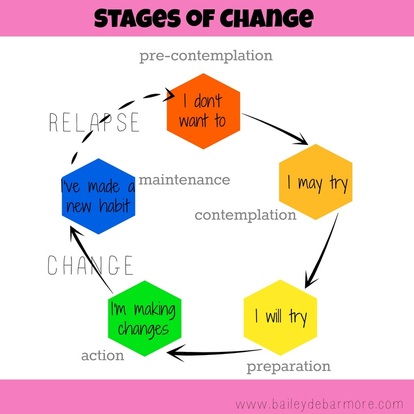
- Precontemplation - this stage there is no thought or urge to even entertain the thought of quitting substances. In this stage you as a counselor will have to roll with any resistance you might encounter from clients.
- Contemplation - step 2 is the stage where clients become aware of some of the negative consequences that they are facing due to substance abuse - but they are NOT ready to change yet. Here clients have identified a problem and are only entertaining the though of doing something different.
- Preparation - the "I want to change" stage. Here clients will be seeking change and begin going through proper steps to change. Many clients might skip this stage and go straight to the action step, which mat lead to them relapsing because they are ill prepared. Some preparations include entering rehab facilities, intensive outpatient programs, seeking out counselors, or searching for help from other professionals such as medical doctors or psychologists. This stage prepares clients for sobriety by informing them of the action and maintenance stages they'll be engaging in.
- Action - this is the actual working stage. Going to AA/NA meeting, meeting with helping professionals, changing their social setting, and/or engaging in self-directed behavioral change are just some things you can expect to see from your clients in this stage. In this stage your clients are working to remain sober, you aren't convincing them to not use but instead are strategizing with them healthy social/environmental alternatives so they can remain sober.
- Maintenance - this is where you clients will continue to do what they have learned while in the active phase. Such activities include going to AA meeting, continuing to meet with counselors, continuing to engage in activities that contribute to their sobriety. Its important to note that although AA was noted as an example, this is not a requirement for clients' sobriety, many people get sober without the help of AA or their services.
- In the case of relapse, this process begins all over the again with precontemplation. According to the National Institute on Drug Abuse, approximately 40-60% of all substance abusers relapse, so there is a high possibility that you will have clients that are constantly going through this process. Although this is not always the case and it would not be advised that you approach your clients with this mentality.
Minus the maintenance stage, which ideally should be life long, the stages of change should take a couple of months. As a counselor you should be able to see your clients progressing through the stages - also be mindful that this is not a fluid process. That means that once your clients have to fully complete one stage before moving on to the next, so if your client is looking at detox centers in one session but then continues to use - your client is still in the precontemplation/contemplation stage. Below is a diagram that expresses the stages in a circular manner (incorporating relapse into the change process.)
Here you can hear me further discuss stages of change when dealing with adolescents. Enjoy!
Friday, March 20, 2015
Basically.... Let's go international!!
As you have already suspected, people ll over the world experience depression, anxiety, suicidal ideations, bi-polar disorders, and other mental health illnesses. Today we look at international counselors, in the sense of American counselors who travel to another country to counsel and counselors in born and raised in different countries. Lets start by discussing opportunities for counseling abroad.
For those like me who are interested in traveling and living abroad, international counseling may be a route for counselors to consider. There are many jobs abroad that are now coming to seek counselors to help infleuence their communities and companies. So if you're like me, you're probably thinking "well can I go abroad to counsel?" Well of course you can! You just have to go out and look for the opportunity to do so!
Where do I start?
Glad you asked, I'll go over some job sites that are currently seeking counselors. However you should be advised that some of these job offers are through individual organizations so you should do extensive research before you go divulging your personal information online. Abroad.com has a section devoted to counseling jobs overseas, however this jobs are independent organizations. Some of the countries listed are Japan, New Zealand, China, and Germany to name a few.
International School Services has a list of international schools that are seeking counselors for different countries. However if you are not wanting to work closely with children, this site is not the one for you. Lastly USAJobs.gov has a section for recent graduates seeking employment, so for those in my position, this is an ideal place to start for me. Listed below are other sites that I've come across but have mixed feelings about their authenticity, so proceed with caution:
So I've looked over the sites and I'm ready to start the applications! But wait, what's the catch-22?
Well here are some stipulations to counseling abroad that I've come across:
For those like me who are interested in traveling and living abroad, international counseling may be a route for counselors to consider. There are many jobs abroad that are now coming to seek counselors to help infleuence their communities and companies. So if you're like me, you're probably thinking "well can I go abroad to counsel?" Well of course you can! You just have to go out and look for the opportunity to do so!
Where do I start?
Glad you asked, I'll go over some job sites that are currently seeking counselors. However you should be advised that some of these job offers are through individual organizations so you should do extensive research before you go divulging your personal information online. Abroad.com has a section devoted to counseling jobs overseas, however this jobs are independent organizations. Some of the countries listed are Japan, New Zealand, China, and Germany to name a few.
International School Services has a list of international schools that are seeking counselors for different countries. However if you are not wanting to work closely with children, this site is not the one for you. Lastly USAJobs.gov has a section for recent graduates seeking employment, so for those in my position, this is an ideal place to start for me. Listed below are other sites that I've come across but have mixed feelings about their authenticity, so proceed with caution:
- http://www.oacac.com/jobs
- http://www.learn4good.com/jobs/schoolcounselor/united_arab_emirates_uae/postings/
- http://boards.bootsnall.com/volunteeringworking-as-a-therapist-abroad-t30139.html
So I've looked over the sites and I'm ready to start the applications! But wait, what's the catch-22?
Well here are some stipulations to counseling abroad that I've come across:
- Your should be fluent in the language of the host country that you are traveling to.
- Well if you think about it this makes perfect sense, why would you hire a someone from a different country who you are unable to communicate with?
- You'll have to be licensed.
- Almost all the positions that I looked into required a licensed counselor, social work, MFT, etc. They also usually specified that there be a minimum time period that you experience in the specific job area.
- Think about it - as an employer I'll have to go through hoops to legally employ you so I better make sure you're worth the trouble!
- You might have to work in a rural area.
- Many of the positions that I've come across have been with partner organizations that are targeted at improving developing countries where you might not have certain luxuries.
- You might have to be willing to take a pay cut.
- Like I've previously stated you might be staying in rural areas where your working with a private organization that has low funding but high enthusiasm for helping others. You'll probably receive food, shelter, and other basic needs met, however there actual pay that you'll receive may be much lower than you're used to.
- This disclaimer does not apply to jobs offered through the US government, such as being a traveling counselor on military bases.
- Your position might be temporary.
- Depending on the stipulations in your contract or the agency you go through, the gig might be up in a couple months! This means that you have to consider if you're financially stable enough to move, if your family would be moving with you (if you have a partner and/or children), among many other things.
Till next time!
Tuesday, March 17, 2015
Basically.... mental health looks different on each person!
This is a little different from my normal posts, however I think that it is important to emphasize the true importance of encouraging others to seek treatment for their mental illness. At my internship site there has been a recent death of a former patient. One of the patients was going through detox and having difficulty with that experience of a newfound sobriety. This patient was a middle aged man with a wife and children, working, and an overall productive member of society. He had recently decided to stop his substance use and begin the path to sobriety. One dilemma that quickly arose for the patient was his pain increased pain from his chronic illness. Although the patient had been suffering with this pain for years, recently his pain had worsen so much that he eventually began experiencing anxiety surrounding the spontaneous onset of his pain as well as depression from his inability to stop the pain. When I saw this patient he was very much upset about his life in general, he spoke very little and when he did he spoke negatively about his life and his circumstances. Shortly after our initial meeting at the hospital, I was informed that this patient had committed suicide Initially this incident took me by surprise because I felt that there were no warning signs that he gave to me, my supervisors, or other groups members that he was even thinking or planning on committing suicide. After a couple days of dwelling on this patient, I was still highly bothered by the actions of the patient. From my perspective this patient had everything to live for, he was sober, going to seek treatment from the doctor about his pain, and was rebuilding his relationship with his family. It was at that moment that I was reminded of the magnitude of mental health on an individual. Just like other illnesses, mental health can be severe such as bi-polar disorder or schizophrenia, or less severe such as depression or anxiety. Regardless of the case, this is a serious disease that can ultimately claim one's life if untreated. One way to ensure treatment is through discussion and information of illnesses. Regularly talking about the signs and symptoms of mental illness not only normalizes it, but helps other to realize that they are not alone and that help is out there if they seek it!
Subscribe to:
Posts (Atom)